Published
11 minute read
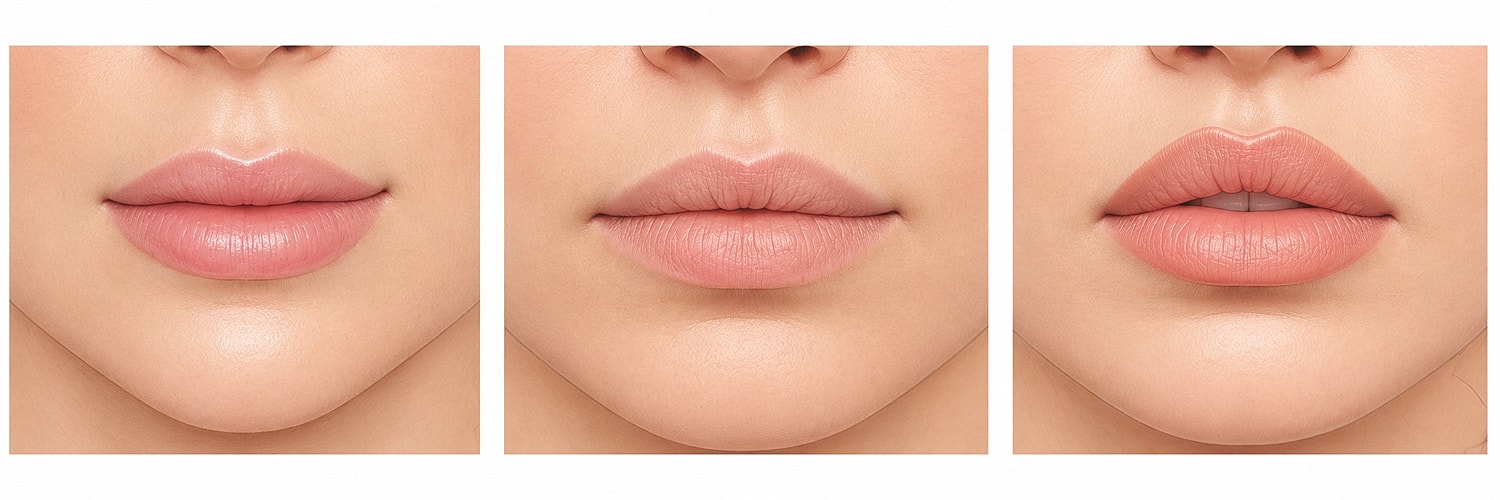
There is something interesting about the way we age around the mouth. The changes are subtle. The upper lip lengthens. Less of the upper teeth show when we're relaxed. The corners of the mouth settle and the definition that made the lips look youthful gradually softens.
You don't notice these changes individually. We simply look in the mirror one day and feel that something is different. And, very often, they assume they need more volume.
As a plastic surgeon, I think that's where we need to begin asking better questions. Sometimes the problem isn't that the lips have lost volume. It's that they've lost their position. Which are two very different things.
A Beautiful Lip Is About More Than Fullness
Over the years, cosmetic medicine has increasingly associated youthful lips with fullness. Lip fillers have become extraordinarily popular, and in the right patient, they can produce beautiful, natural improvements.
But there is a limitation to what volume alone can accomplish. The soft tissue and dynamics have to be considered.
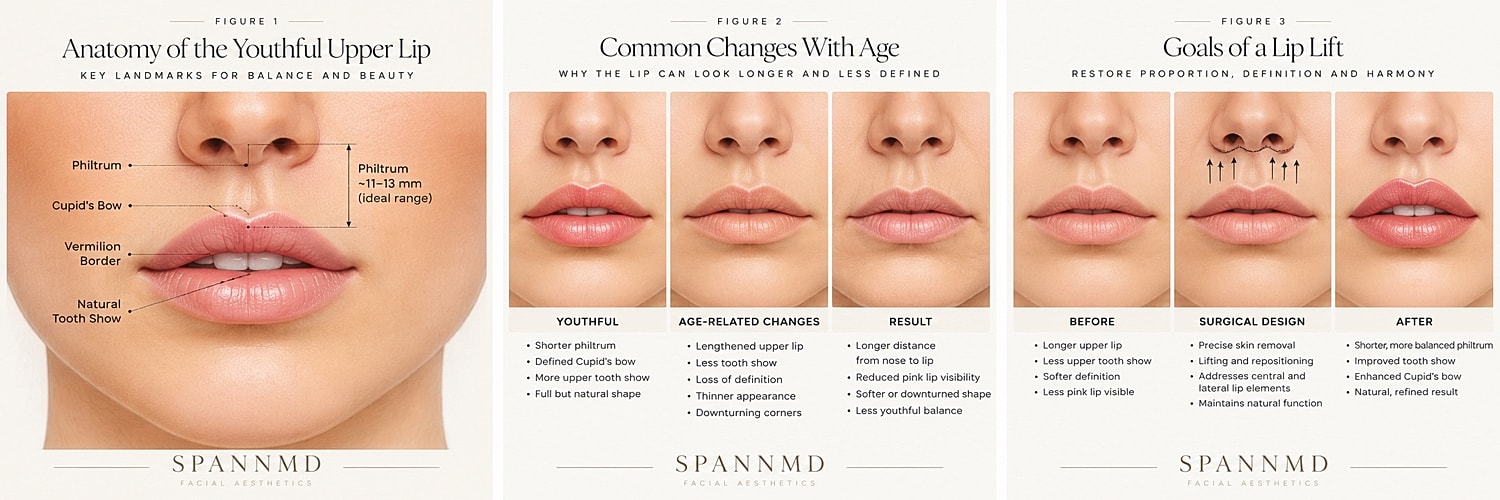
Imagine a patient whose upper lip has gradually lengthened. The distance between the nose and the pink portion of the upper lip (an area called the philtrum) increased. The upper lip may also roll inward, making the visible pink portion appear thinner.
Adding filler may improve fullness but it doesn’t correct the underlying length of the upper lip.
In fact, adding too much volume to an already elongated lip can sometimes make the area appear heavier or less defined. That’s why I believe lip rejuvenation should begin with an assessment of proportion rather than a discussion of how many syringes we might need.
The goal should never be to create someone else's lips.
The goal is to restore the best version of your own anatomy.
What Is a Lip Lift?
A lip lift is a surgical procedure designed to shorten the distance between the base of the nose and the upper lip.
By carefully removing a measured amount of skin, a surgeon can reposition the upper lip, improve the visibility of its natural pink border, and, in selected patients, reveal a little more of the upper teeth.
Unlike filler, which adds volume, a lip lift changes the position and proportion of the upper lip.
A well-designed lip lift may:
- Shorten an elongated upper lip.
- Improve the definition of the Cupid's bow.
- Increase the visible pink portion of the upper lip.
- Restore a more youthful relationship between the lips and upper teeth.
- Improve facial balance without creating excessive fullness.
That last point is particularly important to me.
A successful lip lift should not announce that surgery has been performed. It should simply make the mouth look more harmonious with the rest of the face.
What the Deep Plane Lip Lift Research Teaches Us
A particularly interesting publication in Aesthetic Surgery Journal examined the CUPID lip lift, an advanced approach developed by facial plastic surgeons Dr. Benjamin Talei and Dr. Steven Pearlman.
Their work, published in 2022, was based on a large retrospective surgical experience and explored something I've always considered central to aesthetic surgery: the relationship between surgical design, natural anatomy, and long-term appearance.
Rather than treating the upper lip as a single structure that needs to be uniformly elevated, their approach considers the different ways the central and outer portions of the lip move. I believe this distinction matters.
When the center of the upper lip is lifted without enough attention to its outer portions, the result can look unnatural. The middle may become disproportionately elevated while the edges remain low. Ben described in his article how carefully designed lifting vectors, deeper tissue release, and selective treatment of the mouth corners can help produce a more balanced result.
Their research also highlights the importance of maintaining normal lip mobility and avoiding excessive skin removal.
What I find most valuable about this work isn't simply the technique; it's the philosophy behind it.
Aging occurs in multiple dimensions. Correcting one measurement without respecting the surrounding anatomy can create a new problem.
That principle applies just as much to a lip lift as it does to a facelift.
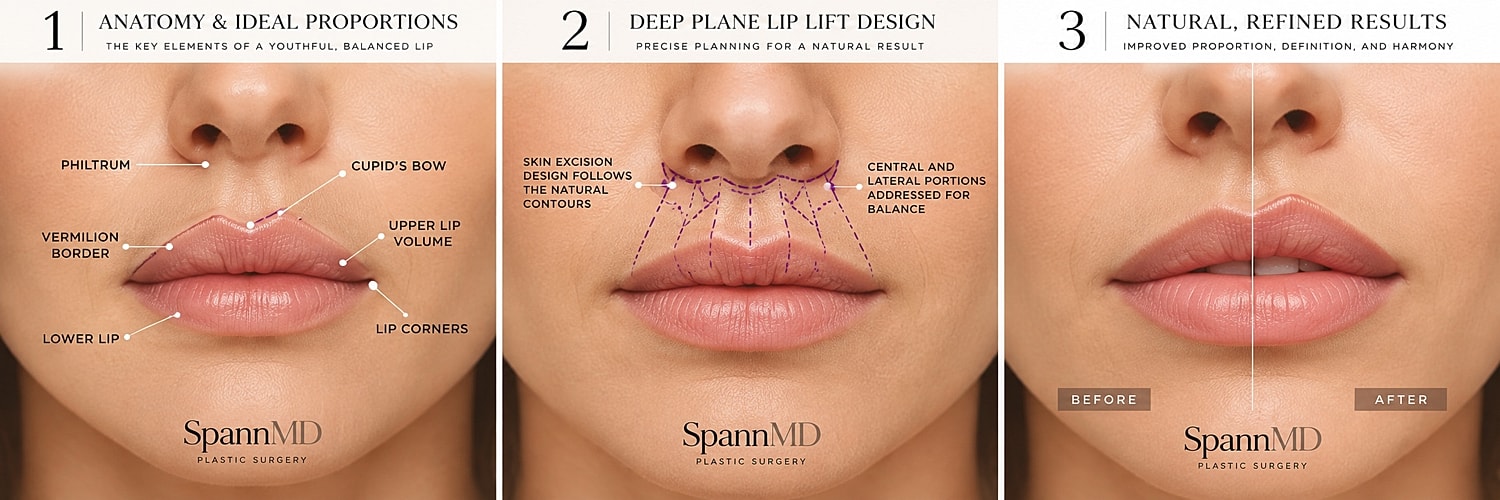
The Corners of the Mouth Matter
One of the details that is frequently overlooked in lip rejuvenation is the position of the mouth corners.
The central upper lip and the outer portions of the mouth don't age in exactly the same way. The center of the lip is closely related to the nose and upper teeth. The outer portions are influenced more by the surrounding facial tissues and their gradual descent.
As a result, a patient may have an elongated upper lip along with downward-turning mouth corners. Lifting the center alone may make the contrast more noticeable.
In certain patients, a carefully designed corner lip lift can improve the visible pink lip along its outer portions or soften a downward-turning appearance. But this requires restraint.
Lift the corners too aggressively and the mouth can develop an unnatural, always smiling appearance. For me, the objective isnt’ to create a smile at rest. It's to restore a natural, relaxed look.
Lip Lift vs. Lip Filler: Which Is Better?
This is one of the most useful distinctions I discuss when evaluating the aging face.
Lip filler adds volume. A lip lift changes position.
Neither treatment is better. They simply address different worries. If your upper lip is naturally short and well-positioned but lacks volume, filler may be the more appropriate choice. sIf your upper lip has lengthened, the pink portion has become less visible, and you want a more defined shape without additional bulk, a surgical lip lift may offer a more appropriate structural solution.
Some patients benefit from a combination of approaches and there’s another consideration: previous filler.
Over time, filler can sometimes accumulate or migrate beyond its intended location, creating fullness in the skin above the lip rather than within the pink lip itself. When that happens, adding more filler may compound the problem. Occasionally, the most important first step is to evaluate whether existing hyaluronic acid filler should be dissolved before deciding on further treatment.
Then not every thin-appearing lip needs augmentation. Sometimes it needs less volume. Sometimes it needs repositioning. Sometimes it needs nothing at all. Knowing the difference is an important part of surgical judgment.
The Smile Is Just as Important as the Lip
One of the more fascinating elements of upper lip anatomy is its relationship to the teeth.
When we are young, a small amount of the upper front teeth is often visible when the mouth is relaxed. As the upper lip lengthens with age, that visibility can diminish. A lip lift may restore some of this natural tooth show. But more isn’t always better.
The relationship between the upper lip, teeth, and underlying facial skeleton must be evaluated carefully. Excessive shortening can expose too much of the teeth or interfere with comfortable mouth closure. That's why I look not only to how a patient's lips are at rest, but also to how they move.
I want to understand their smile, their natural asymmetries, and how the muscles around the mouth function. An attractive result should look natural when someone is talking, laughing, and smiling. Not just when they're sitting perfectly still for a photograph.
What About the Scar?
A lip lift generally requires an incision near the base of the nose, where the natural contours of the nostrils and surrounding skin can help make the scar less noticeable. Careful incision design and meticulous closure are essential. However, no surgical incision is truly scarless.
The eventual appearance depends on several factors, including skin characteristics, wound healing, tension, and the extent of surgery. Deep plane approaches may reduce tension at the skin closure by redistributing support through deeper tissues, but they also involve more extensive dissection and potentially longer swelling. A technique shouldn't be judged only by how attractive the immediate postoperative photographs appear. Healing, function, scar quality, and the long-term result all matter.
How Long Does a Lip Lift Take to Heal?
Patients often assume that because a lip lift involves a relatively small area, recovery must be minimal. That isn't always the case. Swelling, tightness, temporary asymmetry, and changes in smiling can occur during the healing process.
Individual recovery varies, of course, and less extensive procedures may follow a different timeline. The point is that the lips are constantly moving. We use them to speak, eat, smile, and express emotion.
Is a Lip Lift Part of a Facelift?
Not automatically. I recommend a lip lift when anatomy commands it.
A facelift primarily addresses descent and laxity in the cheeks, jawline, and neck. Even an expertly performed deep plane facelift does not directly shorten an elongated upper lip. That means a patient can achieve excellent facial and neck rejuvenation while still noticing age-related changes around the mouth. This is one reason I believe in evaluating the face as a whole.
For some patients, the right plan might involve a facelift combined with targeted treatment around the mouth. For others, a lip-focused procedure may be considered independently. And when fine lines, pigmentation, or skin texture are part of the concern, laser resurfacing may also deserve consideration. A lip lift repositions tissue. A laser addresses aspects of skin quality. Filler replaces or adds volume.
Those are different tools, each with a specific purpose. My preference is to use the fewest interventions necessary to achieve a balanced result.
Who Is a Good Candidate for a Lip Lift in Northwest Arkansas?
A lip lift may be worth discussing if you've noticed that your upper lip has become longer, your upper teeth are less visible when your mouth is relaxed, or your lip shape no longer has the definition it once did.
It may also appeal to someone who wants improved lip shape without continually adding filler.
However, not everyone is a candidate.
A naturally short upper lip, excessive tooth show, difficulty closing the lips comfortably, certain dental relationships, or prior surgery and filler complications may change the recommendation.
The most important part of a consultation is determining whether changing the upper lip will genuinely improve the overall facial appearance.
Surgery should never be performed simply because a particular measurement falls outside an arbitrary ideal.
There are beautiful faces with short lips and beautiful faces with longer lips.
The objective is balance, not conformity.
My Philosophy: Restoration, Not Reinvention
If there is one principle that guides my approach to aesthetic surgery, it is that natural results come from respecting the structures that already make a face distinctive.
I don't believe every patient needs fuller lips, higher cheeks, or a sharper jawline.
I believe patients want to look refreshed without losing the features that make them recognizable.
It's easy to make a lip shorter.
The art is knowing how much to change and when not to change it at all.
For patients considering facial rejuvenation in Bentonville, Fayetteville, Rogers, or elsewhere in Northwest Arkansas, my recommendation is simple: begin with a thoughtful evaluation of the entire face rather than focusing on one isolated feature.
Because the most beautiful aesthetic results rarely come from doing more.
They come from doing precisely what's needed.
Considering a Lip Lift or Facial Rejuvenation in Northwest Arkansas?
I welcome the opportunity to discuss your concerns, examine your facial anatomy, and help you understand which options may be appropriate—whether that's a surgical procedure, a nonsurgical treatment, or no treatment at all.
My goal is to help you make an informed decision with a clear understanding of the potential benefits, limitations, and recovery.
Schedule a private facial rejuvenation consultation with Dr. Michael Spann through SpannMD.com.
Michael Spann, MD, is a board-certified plastic surgeon with approximately two decades of experience in aesthetic and reconstructive surgery, serving patients in Little Rock and Northwest Arkansas.
Reference
Talei B, Pearlman SJ. CUPID Lip Lift: Advanced Lip Design Using the Deep Plane Upper Lip Lift and Simplified Corner Lift. Aesthetic Surgery Journal. 2022;42(12):1357–1373.
This article is educational and discusses published surgical techniques. The appropriate procedure, surgical approach, and expected recovery must be determined during an individual consultation.