Published Jul 26, 2026
5 minute read
Threads, Filler, or a Facelift? An Honest Answer About Value
By Michael Spann, M.D., Board-Certified Plastic Surgeon
Every week a patient sits across from me and asks some version of the same question. Can't I just do threads instead? It's a fair question. Thread lifts get marketed everywhere as the lunchtime facelift. Less money, no surgery, back to work tomorrow. I understand the appeal, believe me. So let me answer it the way I'd answer my own family. The short answer is no. Threads don't offer real value when you compare them to the longevity of a facelift. Not because they're a scam. They do something. The problem is what they do, how briefly they do it, and what they end up costing once you repeat them long enough to matter.
WHAT THREADS ACTUALLY DO A thread lift places dissolvable barbed sutures under the skin and gathers the surface tissue upward. The change is real, but it's modest, and it's temporary. Most patients get 12 to 18 months before the sutures dissolve and the tissue settles back where gravity wants it. Here's what those ads never explain. Facial aging isn't mainly a skin problem, and it isn't mainly a volume problem. The deeper layer of the face, the SMAS and the ligaments that anchor it, loosens and drops over decades. Jowls, a heavy jawline, a softening neck. That's deep tissue falling. Threads tug on the surface. A deep plane facelift releases those retaining ligaments and repositions the deep layer itself, without tension, back where it sat in your forties. That's the whole reason one lasts a season and the other lasts a decade or more. You can't suspend a structural problem on a dissolvable suture. You can only reposition it.
THE MATH NOBODY SHOWS YOU Now the money. In my practice, a deep plane facelift is a $20,000 investment, made once. A thread lift session typically runs $2,000 to $4,500 and needs repeating every 12 to 18 months. A liquid facelift of filler and biostimulators costs somewhere around $2,500 to $4,000 a year to maintain. Those numbers sound smaller than surgery. They are, right up until you carry them across a decade, which is the honest timeframe, because a facelift is a decade plus result.
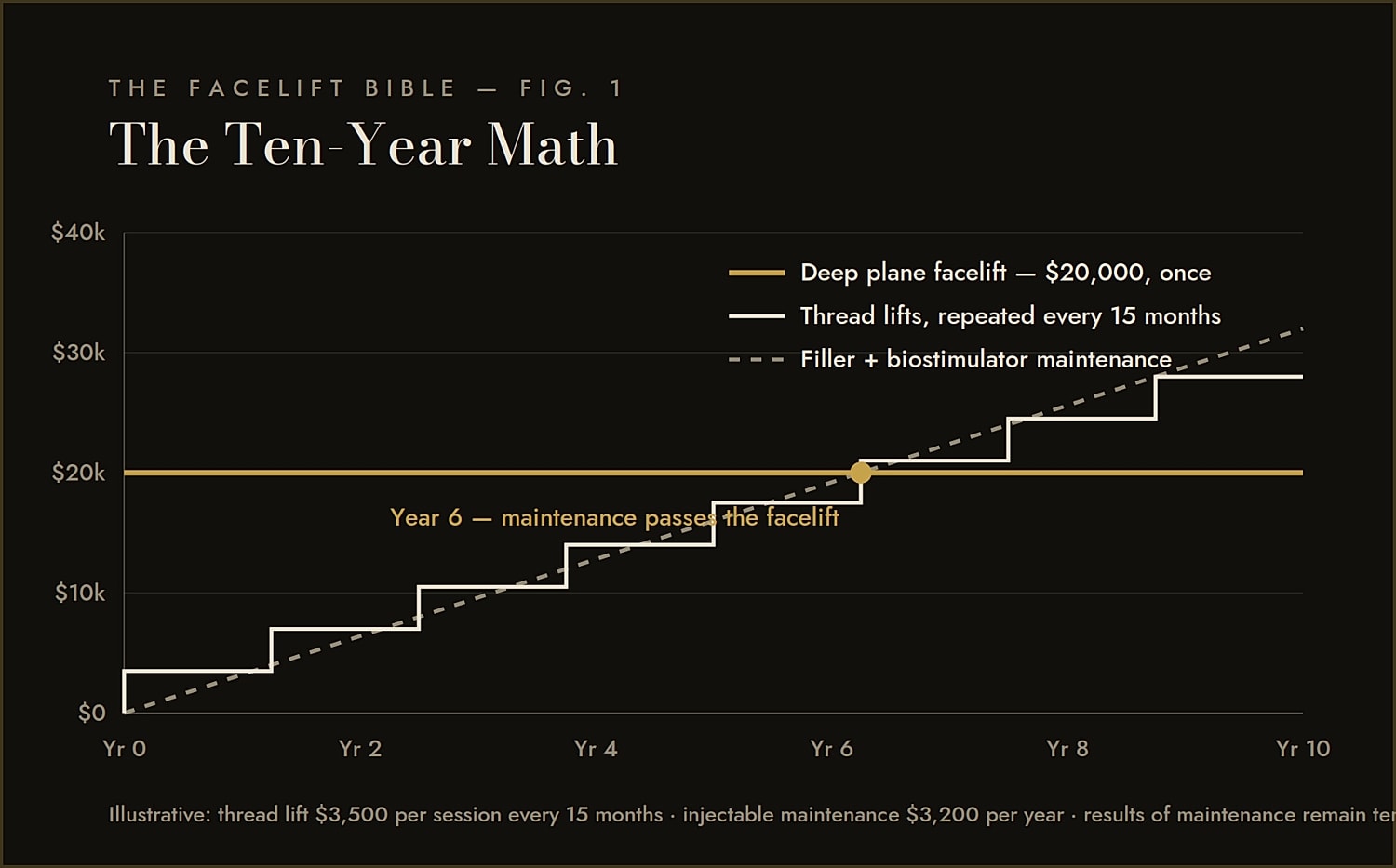
Run the math and the maintenance path passes $20,000 by about year six. By year ten it's over $30,000. And here's the part that matters most to me as your surgeon: at the end of that decade, you still don't have facelift results. You've spent facelift money renting a temporary effect while the underlying descent kept right on going. Many of those patients end up needing the facelift anyway. I'd call that the opposite of value.
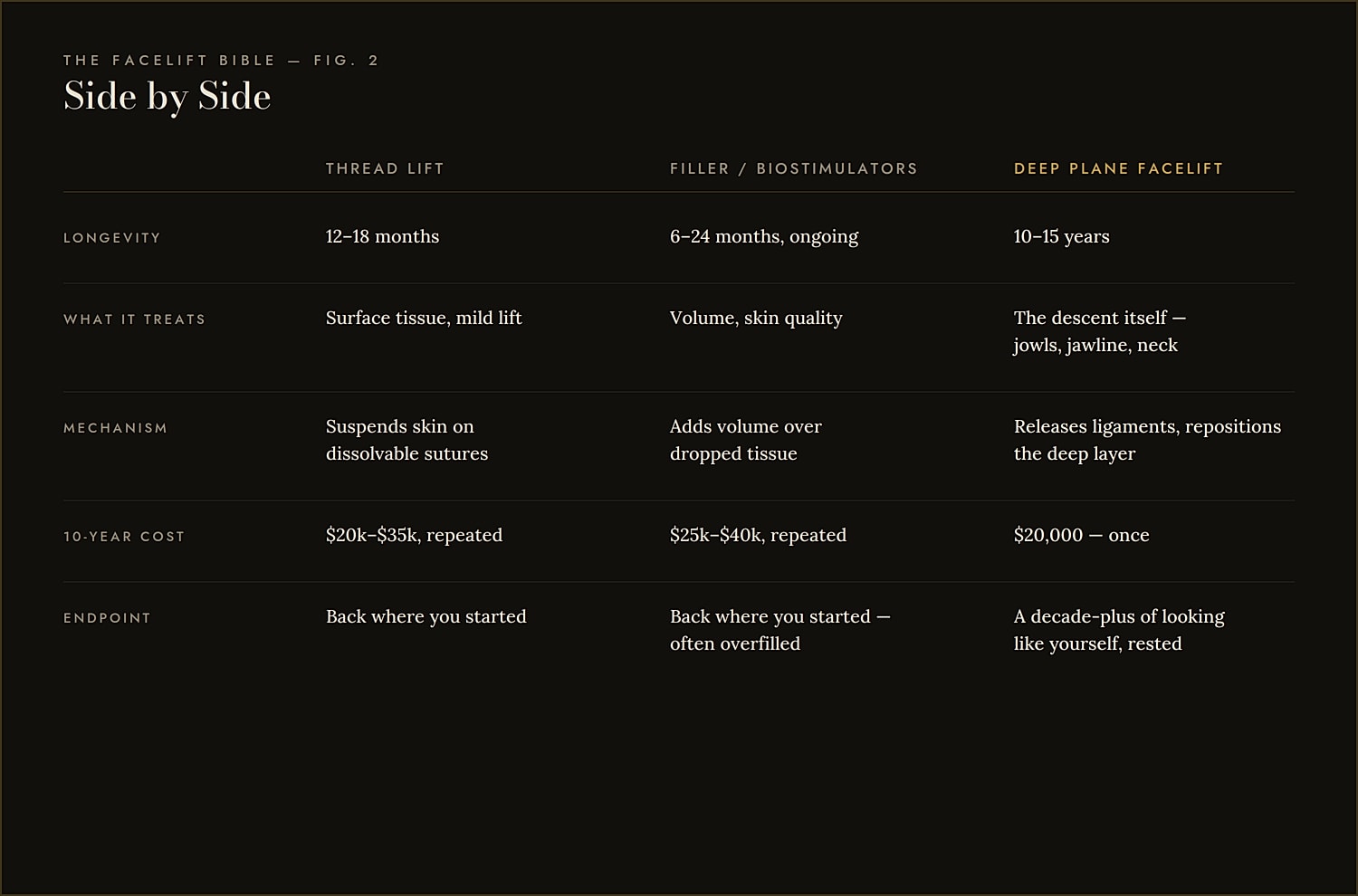
WHERE I'LL DEFEND THE NONSURGICAL SIDE I want to be fair here, because value cuts both ways. Injectables are the right tool for early volume loss in your thirties and forties, for lips, and for skin quality. They're also right for patients who aren't surgical candidates or simply aren't ready. In my practice they work alongside surgery, not against it. What I won't do is watch a patient with true jowls and a heavy neck spend five years and twenty thousand dollars chasing a surgical problem with nonsurgical tools. Filler stacked over descended tissue doesn't lift a face. It widens it. That's where the overfilled look comes from, the one everybody recognizes and nobody wants. The kindest thing I can tell that patient is the honest thing. You have a structural problem, and structure is what surgery is for.
THE QUESTIONS I HEAR MOST Do thread lifts actually work? They produce a real but modest change that fades within 12 to 18 months as the sutures dissolve. They never touch the deeper structures, which is why the effect is both limited and temporary. Isn't a thread lift cheaper than a facelift? Per session, yes. Over time, no. Repeating threads every 12 to 18 months passes the $20,000 cost of a deep plane facelift by about year six, and you never get facelift results along the way. Can threads or filler ever replace a facelift? No. They address volume and surface. Aging is a descent of deep tissue, and only surgery repositions that tissue. That's not my opinion. It's anatomy. Why do some faces look overfilled? Because filler was asked to do a facelift's job. Volume layered over descended tissue widens and distorts the face instead of lifting it. The right diagnosis, and some restraint, prevents it. What makes a deep plane facelift last so long? It releases the retaining ligaments and moves the deep layer of the face and neck as a unit, with no tension on the skin. Because the correction is structural, it holds, typically 10 to 15 years. And it looks like you, not like a procedure. So when is nonsurgical the right call? Early volume loss, lips, skin quality, and patients who aren't candidates or aren't ready for surgery. In that role, injectables are excellent. As a facelift substitute, they're the most expensive way to stay where you are.
GET THE HONEST ANSWER FOR YOUR FACE Sometimes my answer in consultation is surgery. Sometimes it's "you don't need me yet." Either way, you'll leave knowing exactly where you stand and what actually offers value for your face.
Request a consultation at spannmd.com, or call 501-219-8000.
Little Rock and Northwest Arkansas. Michael Spann, M.D. Double Board-Certified, Plastic and Reconstructive Surgery Deep Plane Facelift and Deep Plane Neck Lift AAAASF-Accredited In-House Surgery Center